Narrow Gauge, Wide Delays
Read next: Crossing into and Through the Country
The railway map looks more useful than the railway is.
A Network Built for Another Country
Bosnia and Herzegovina has roughly 1,000 kilometres of active rail line — a figure that sounds respectable until you ride any of it. The network was designed and built, in its modern form, during the Yugoslav period to serve an integrated federal economy: raw materials moving from inland extraction sites toward processing plants and ports, finished goods and passengers flowing along corridors that made sense when Sarajevo was one node in a larger system rather than the capital of a landlocked independent state. The logic was Yugoslav. The infrastructure remains.
The gauge tells part of the story. Most of the working Bosnian network now runs on standard gauge (1,435 mm); the 760-millimetre narrow gauge is a legacy — inherited from the Austro-Hungarian military railways of the nineteenth century, which chose it for its cheapness in mountain terrain. Yugoslavia later added some standard-gauge (1,435-millimetre) track, and the main line connecting Sarajevo northward through Zenica and Doboj to Banja Luka and onward to Zagreb and Budapest was standard-gauge by the time the federation collapsed. That line — the only one Bosnia shares with the European main-line network — survived the 1990s war in fragmented condition and has since been only partially rehabilitated. The narrow-gauge heritage network, which once wound through Herzegovina and the Neretva valley, is largely decommissioned.
What operates today is, in practical terms, two separate systems under one country. Željeznice Federacije Bosne i Hercegovine (Railways of the Federation of Bosnia and Herzegovina, ŽFBH) manages track and operations within the Federation entity. Željeznice Republike Srpske (Railways of Republika Srpska, ŽRS) manages its own. The two companies do run trains across each other's territory on through routes, but they operate under separate management, separate finances, and separate political oversight. Coordination is bureaucratically costly and commercially thin.
What the Timetable Actually Offers
The flagship passenger service is the Sarajevo–Banja Luka route, traversing the length of the country on the standard-gauge main line. The journey covers roughly 250 kilometres and takes between four and five hours depending on the service, which implies an average speed of around 50 to 60 kilometres per hour on a good day. That is not a typo. The permitted track speed across much of the route is between 60 and 80 kilometres per hour because of the condition of the permanent way — the sleepers, ballast, and rail — and the curvature of the mountain sections. Decades of deferred maintenance have not been reversed by the rehabilitation funds that have arrived, which covered priority sections but not the whole system.
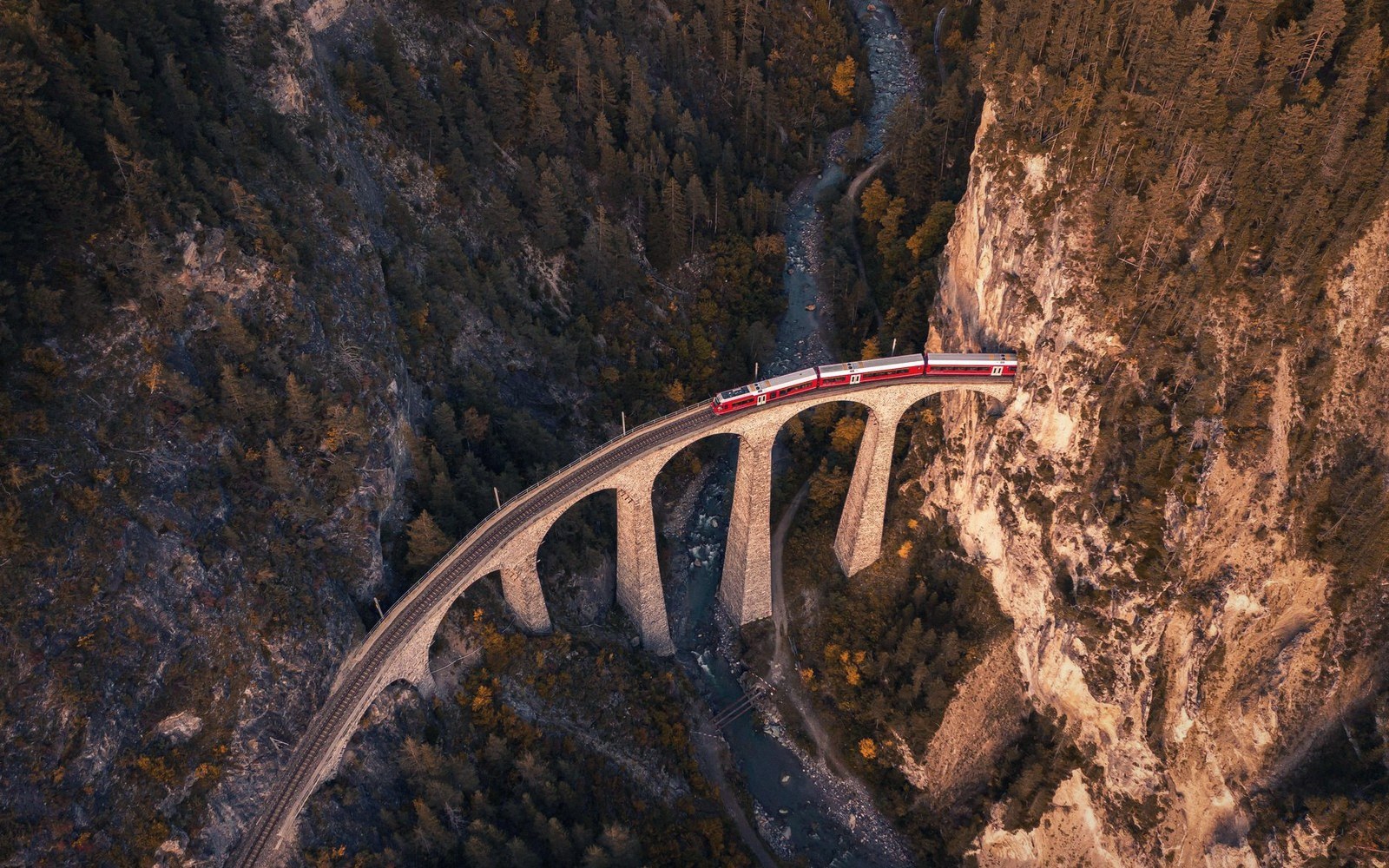
The Sarajevo–Mostar line descends through the Neretva canyon in a series of curves and tunnels that are genuinely dramatic and genuinely slow. The roughly 130-kilometre journey takes close to two and a half hours. There is a single daily return service. For a route connecting the country's two most significant cities, one train each way per day is the complete offer. Bus services on the same corridor are faster and more frequent, which explains why the bus won and the railway did not.
Freight is the network's more serious business, at least in volume. Coal from Zenica and Tuzla moves by rail. Steel and metal products from the industrial corridor follow the same tracks. Wood and timber products load onto wagons for export via Croatia. This freight traffic is what financially justifies most of the network's continued operation; passenger revenue alone would not. But even freight is constrained by line capacity, the condition of rolling stock, and slow average transit times that push larger shippers toward road haulage when the commodity allows it.
The Gap Between Map and Motion
Bosnia's railway problem is not principally technical — it is institutional and financial. Maintenance is chronically underfunded across both entity networks. The rolling stock is old; locomotives and passenger carriages purchased or inherited before 1992 make up a large share of what is running. New investment requires agreement not only within each entity but, for any through-route, between entities that answer to different governments and have different fiscal capacities. European Union pre-accession funding has reached the sector but project implementation is slow, and the corridor running north to south that will define the country's road future has no rail equivalent at comparable ambition or financing.
International connectivity is thin. The line north to Zagreb and then to Budapest and the wider European network is the country's one serious international rail link, and it is used more by freight than by passengers. There is no direct rail connection to Serbia's network in operational regular service. Connections to the Adriatic — which Yugoslav planners envisioned as a key trade route — exist on paper but require changes and long detours that make the journey competitive with nothing.
The result is a network that covers the geographic silhouette of the country tolerably well on a map, serves some freight flows that have no practical alternative, and delivers passenger transport that is slower, less frequent, and less reliable than the road alternatives for almost every route it runs. The railway is not going away — the infrastructure is too embedded, the freight too dependent — but for a generation of travellers, the rational choice was already made at the bus station, not the platforms.