Sarajevo: A Capital in a Bowl
Read next: Banja Luka and the Weight of Being Second
A city pinned between ridgelines, Sarajevo functions as the country's administrative and services centre — and the mountains that make it scenic make everything else harder.
The Valley That Built a City
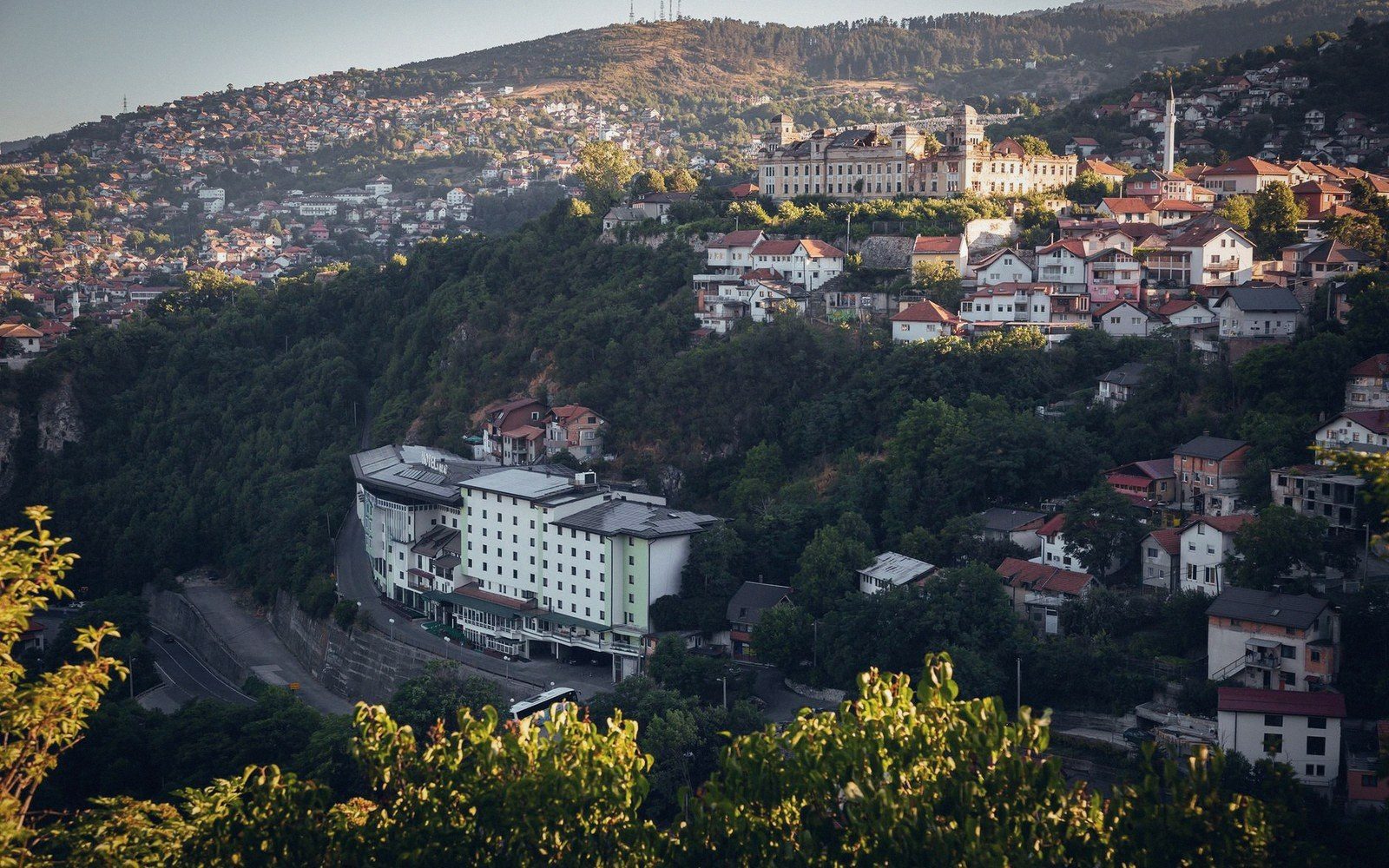
Sarajevo sits in the Miljacka river valley, pressed between steep ridgelines that rise sharply on every side. The bowl shape is immediately legible from any of the surrounding hillsides: a dense urban core threaded along the valley floor, with neighbourhoods climbing the slopes until the gradient defeats them. The city is beautiful because of this geography. It is also constrained by it.
The constriction is not merely aesthetic. Sarajevo Canton — the administrative unit that wraps the city — covers roughly 1,277 square kilometres, but much of that is forested hillside and mountain terrain. The actual developable land is limited, which drives density in the valley, limits the expansion of industrial or logistics facilities that need flat ground, and concentrates pollution during temperature inversions when cold air traps exhaust and particulates above the urban floor. Air quality in Sarajevo regularly ranks among the worst in Europe during winter months, when wood-burning stoves and coal heating compound vehicle emissions in air that cannot easily escape.
Population estimates for the Sarajevo Canton hover around 430,000 to 450,000 people, making it by far the largest urban concentration in Bosnia and Herzegovina. The city proper, Grad Sarajevo, is subdivided into four municipalities — Centar, Novi Grad, Novo Sarajevo and Stari Grad — each with its own municipal assembly. East Sarajevo, across the Inter-Entity Boundary Line, falls inside Republika Srpska and is administered entirely separately, a consequence of the Dayton Agreement's territorial settlement that bisected what had been a single city.
<div class="map-slot" aria-label="Map: Sarajevo Canton boundary and the Inter-Entity Boundary Line separating Sarajevo from East Sarajevo"></div>
Administrative Weight, Economic Gravity
Sarajevo holds a structural dominance in Bosnian public life that the valley geography does not explain but certainly reinforces: everything concentrates here because roads, people and institutions converge on the same bottleneck. The Council of Ministers of Bosnia and Herzegovina meets in Sarajevo. The Court of Bosnia and Herzegovina sits here. So do the central bank, the Indirect Taxation Authority, the main public broadcasters, and the headquarters of most large domestic companies and international organisations operating in the country.
This concentration makes Sarajevo a services city above all else. Finance, insurance, public administration, telecommunications, wholesale and retail trade, and professional services together account for the dominant share of formal employment in the Canton. Manufacturing has declined steadily since the Yugoslav period, and the valley floor offers little room to rebuild it at scale. What remains of industrial activity tends to be in the municipalities at the edges of the Canton or in adjacent areas.
The media sector is notably centralised here. Both the public broadcaster BHRT (Radio-Television of Bosnia and Herzegovina) and the main commercial television networks maintain primary operations in Sarajevo, which means editorial gravity — what gets framed as national news — is shaped by people working in a single valley.
Tourism has grown into a meaningful contributor. The old bazaar quarter of Baščaršija, Ottoman-era architecture, the proximity of ski resorts at Bjelašnica and Jahorina, and the city's layered history draw visitors year-round. The 1984 Winter Olympics left behind infrastructure — bobsled tracks, ski runs — that was damaged during the 1990s siege and has since been partially restored, and the legacy still anchors the city's identity in international conversation.
The siege itself, which lasted from April 1992 to February 1996 and was the longest siege of a capital city in modern warfare, marked the built environment in ways still visible. Bullet-scarred facades persist alongside renovated facades. The Sarajevo Roses — mortar-impact craters filled with red resin on city pavements — remain as deliberate memorials.
Growth pressure has not eased. Housing costs in the Canton have risen sharply, the road network through the valley saturates during peak hours, and the mountains ensure that expansion must climb rather than spread. Sarajevo is a capital city solving capital-city problems in a bowl with finite room.