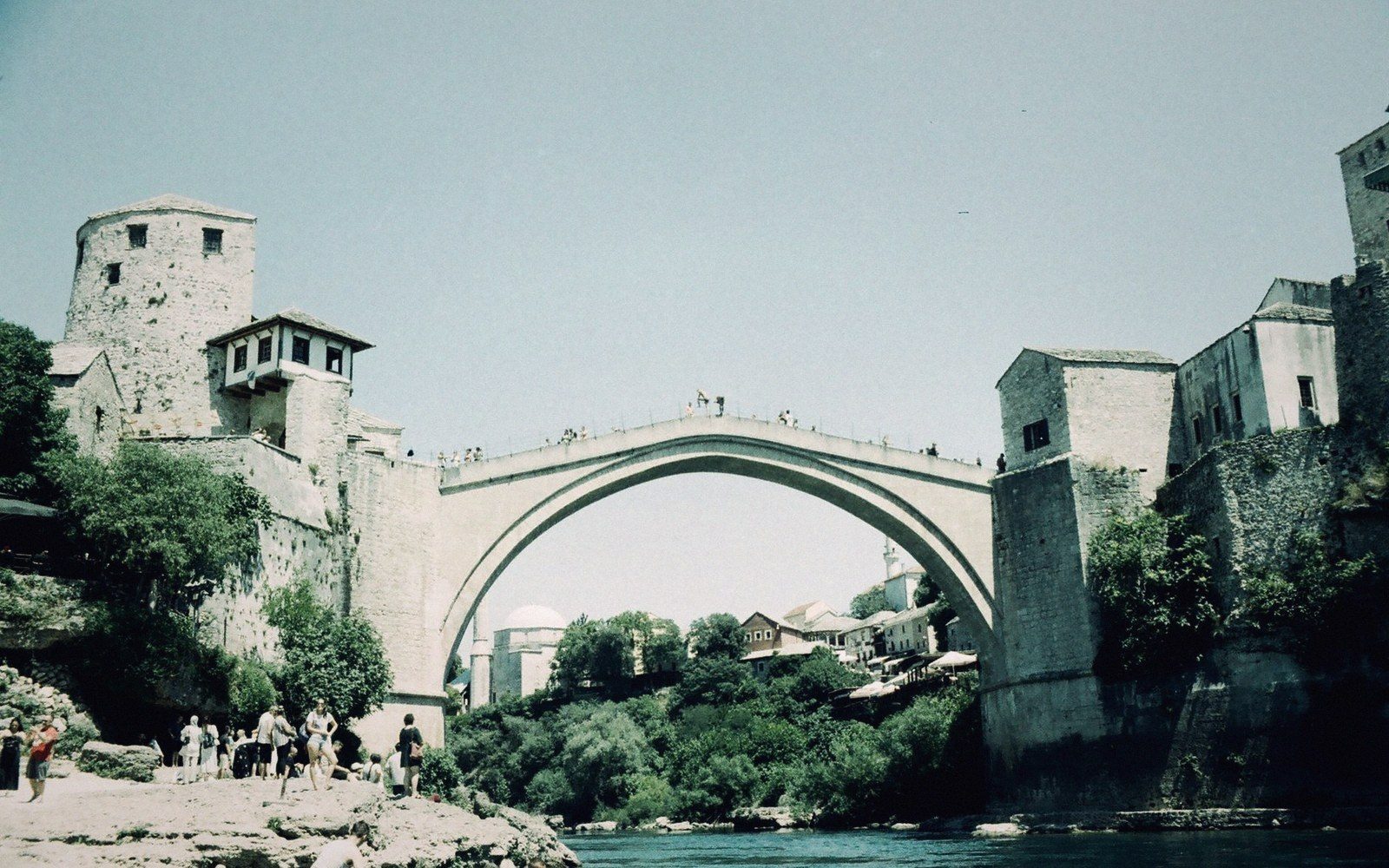
The Neretva Runs Through the Middle
Read next: Tuzla's Salt and What Came After
Mostar is one city by geography and two by administration. The river that runs through it is not the boundary — but the boundary runs nearby, and nearly everything else follows it.
A City That Has Not Agreed on Itself
Mostar sits in the middle Neretva valley, roughly halfway between Sarajevo and the Adriatic, at the point where the river narrows between limestone bluffs and the climate tips decisively toward Mediterranean. Figs ripen on the walls. The water is cold and impossibly green. For most visitors, this is the whole story: the Old Bridge, the divers, the Ottoman quarter, the photograph. For people who actually live here, the city is something more complicated — a municipality that has been functionally divided since the 1990s war and has not, in any meaningful administrative sense, been put back together.
The 1992–1995 war destroyed the original Stari Most (Old Bridge), built in 1566, and left the city split between a predominantly Bosniak east and a predominantly Bosnian Croat west. The bridge was rebuilt and reopened in 2004. The political architecture was not. Mostar remained without a functioning city council from 2009 until 2021 — twelve years in which the two dominant parties, the Party of Democratic Action (SDA) on the Bosniak side and the Croatian Democratic Union of Bosnia and Herzegovina (HDZ BiH) on the Croat side, could not agree on an electoral statute that satisfied the Constitutional Court's 2010 ruling. That ruling found the existing statute discriminatory, because it prevented citizens who did not declare themselves as either Bosniak or Croat from standing for the city council. The court required reform. The parties took a decade to deliver it, and the statute that finally produced an election in December 2020 is widely described as a compromise of convenience rather than a principled solution.
The consequence is a city that functions through parallel structures. Mostar has a unified mayor and a unified city administration on paper, but the six city districts — three historically Bosniak, three historically Croat — operate with a degree of informal autonomy that has no real legal basis yet everyone acknowledges. Budgets flow through the city level in theory; in practice, investment decisions, planning permissions, and even basic services have sometimes been steered by communal loyalty rather than municipal logic. Two water companies served different parts of the city for years. Health services, while formally unified under the Federation of Bosnia and Herzegovina's cantonal system — Mostar is the administrative seat of Herzegovina-Neretva Canton — have long been experienced differently depending on which side of the invisible line a resident lives on.
None of this makes Mostar ungovernable in a crude sense. People cross the city daily, businesses operate on both banks, and the tourist economy has no interest in the boundary at all. But the structural paradox is real: the city's economy depends on integration, and its politics resists it.
What the Economy Is Actually Made Of
Mostar's productive economy has three distinct layers, and they do not map neatly onto the political geography.
The first and most visible is tourism. The historic core — the Stari Most and its surrounding quarter, a UNESCO World Heritage Site — draws somewhere between half a million and a million visitors a year in a strong season, the great majority of them on day trips from Dubrovnik, Split, or the Adriatic coast. The tourism economy is almost entirely concentrated in the eastern, Bosniak-majority districts around the old bazaar. Restaurants, craft shops, hostels, and guide services cluster within walking distance of the bridge. The western side of the city, more residential and more commercial in the everyday sense, sees little of this foot traffic. The result is that tourism revenue pools unevenly, which produces its own political resentments alongside its economic benefits.
The second layer is aluminium. The Aluminij d.d. Mostar plant — a smelter established in the Yugoslav period and located on the western edge of the city — was for decades one of the largest industrial employers in the whole of Herzegovina. At its peak it employed several thousand workers directly and sustained a supply and services ecosystem well beyond its gates. The plant drew on hydroelectric power from the Neretva system, and its economics were always tied to the cost of that electricity. When preferential electricity pricing could no longer be sustained under the energy market arrangements of the Federation, Aluminij's viability collapsed. The smelter ceased operations in 2021, leaving a large workforce without jobs and a major gap in the city's formal economy. Efforts to find a new investor or restart production have continued without resolution. The closure is the single most consequential economic event in Mostar's recent history, and it falls almost entirely on the Croat-majority west — which sharpens the perception that the city's two halves are on divergent trajectories.
The third layer is agriculture and agro-industry, rooted in the wider Neretva valley rather than in Mostar proper. The valley is unusually fertile for a region dominated by karst limestone. Citrus, pomegranates, wine grapes, and vegetables grow at scale in the fields south of the city, with the town of Čapljina and the Stolac area feeding into supply chains that pass through Mostar's wholesale markets. Herzegovina's wine production — concentrated in the Trebinje area and around Mostar's own hinterland — has grown commercially and in reputation. This agricultural belt is largely in Croat-majority hands, which means the economic geography of the valley intersects with the ethnic geography of the municipality in ways that are sometimes difficult to disentangle. The Mostar wholesale market and its road logistics form a connective tissue between the valley's farms and the wider Federation market, a function that continues regardless of who controls city hall.
The Bridge as Both Symbol and Stress Test
The rebuilt Stari Most is the most photographed object in Bosnia and Herzegovina. It is also, inadvertently, a useful illustration of how the city actually works. The bridge itself spans the Neretva between the two banks. The tourism infrastructure on the eastern bank is substantially better developed. The western approach is less curated, more ordinary. Both banks share in the UNESCO designation, but the economic benefit flows asymmetrically. International development funding for heritage restoration and tourism infrastructure has tended to concentrate on the eastern quarter, because that is where the fabric is. This is logical from a conservation standpoint and frustrating from the perspective of a city that needs both halves to believe they have something to gain from cooperation.
The 2020 election and the formation of a city council in 2021 restored some basic normality. A budget was passed. Routine decisions could be made. But the structural question that the Constitutional Court identified in 2010 — whether Mostar's governance framework gives all citizens equal standing regardless of ethnic identity — has not been resolved in principle, only managed. The statute that allowed the 2020 election remains contested by civic activists and legal scholars who argue it entrenches the same logic it was supposed to correct.
Infrastructure is where the paradox shows most plainly. Mostar is the natural hub for the Sarajevo–Mostar route — a journey that remains one of the most difficult in the country given the terrain — and for road connections south toward the coast and east toward Trebinje. The city's position makes it a logical logistics centre for Herzegovina. Realising that potential requires investment decisions that a paralysed or fractured city government cannot easily make. The decade without a council was also a decade without a coherent city-level development strategy. Private investment arrived anyway, mostly in tourism and real estate, but it arrived without a plan.
The closure of Aluminij has sharpened the question of what western Mostar does next. The site is large, the infrastructure exists, and there is notional interest in re-industrialisation or conversion to some other use. But decisions of that scale require the city and the canton to coordinate, and coordination between levels of the Federation's canton system has rarely been swift even when politics is not involved. In Mostar, politics is always involved.
What the city is not is static. The tourist economy has grown year on year for most of the past decade, drawing entrepreneurs, refurbishment capital, and new hospitality businesses. Young people from across Herzegovina move to Mostar for university and some stay. The Neretva valley's agriculture is finding export markets for wine and citrus that Yugoslav-era planning never imagined. These are real developments. They happen because the city's geography, climate, and position are genuinely advantageous, and because economic life does not wait for institutions to agree.
But the advantage is underperformed. A city of Mostar's location and heritage, with the valley it commands, ought to be a more productive economy than it is. The gap between what the geography offers and what the governance delivers is not an accident. It is the cost of a structural paradox that both communities have, for different reasons, found easier to live with than to solve.